Best Gorgias Alternatives for E-Commerce Support in 2026

Choosing a Gorgias alternative starts with the reason you are considering a change. Gorgias now combines a helpdesk priced by ticket volume with an AI Agent priced by resolved conversation. It can also perform Shopify actions such as cancellations and shipping-address changes. A useful comparison therefore has to look beyond the old idea that Gorgias offers only assistive AI.
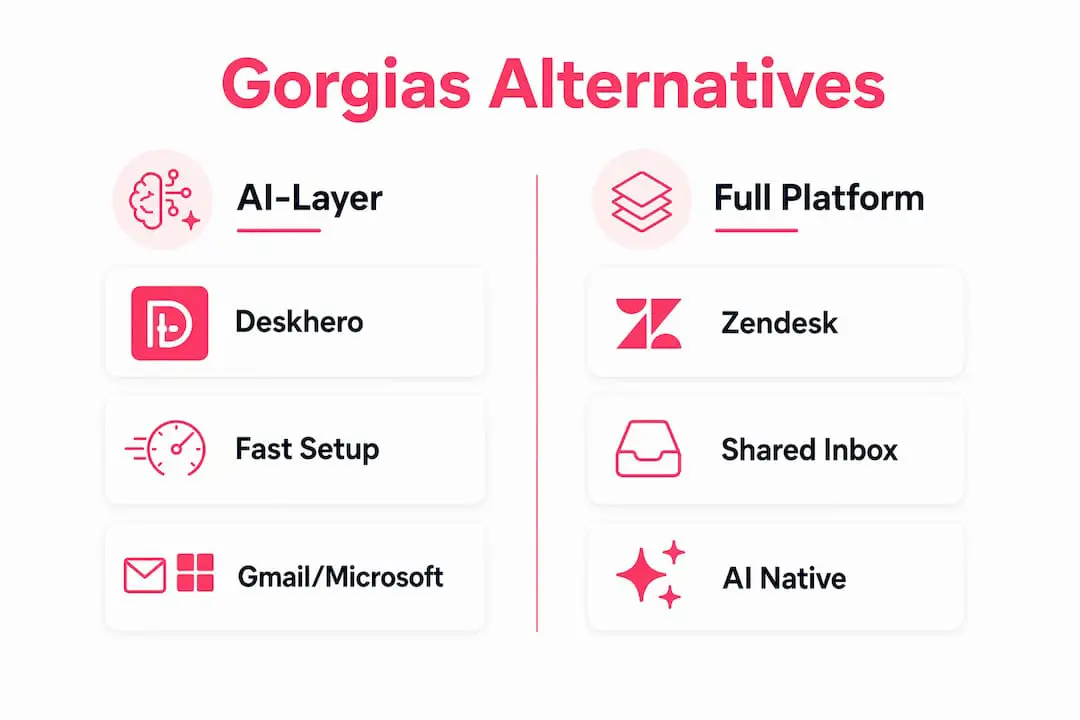
Use this shortlist to decide which type of product deserves a trial:
- Mailbox-first helpdesks such as Deskhero: keep your Gmail, Google Workspace, or Microsoft 365 address while adding a shared inbox, AI drafts, a public FAQ, and optional customer-facing automation.
- E-commerce helpdesks: compare the depth of Shopify actions, AI resolution controls, and pricing at your actual ticket volume.
- Enterprise platforms such as Zendesk and Kustomer: evaluate these when governance, reporting, roles, and multi-brand operations are central requirements.
- Shared-inbox platforms such as Help Scout, Re:amaze, HappyFox, and Kayako: useful candidates when collaboration and user-based pricing matter more than native order actions.
- Conversational and CRM-connected platforms such as Intercom, Front, and HubSpot Service Hub: consider these when messaging or CRM context drives the support workflow.
- Omnichannel platforms such as Freshdesk and Zoho Desk: consider these when email, messaging, social, or telephony need to sit in one system.
Table of Contents
- TL;DR: which alternative fits your situation?
- How do the top Gorgias alternatives compare side by side?
- Vendor-by-vendor breakdown: what each alternative actually does
- How do you choose the right Gorgias alternative for your team?
- What does pricing actually look like after you leave Gorgias?
- Why the resolution model matters more than any feature list
- Key Takeaways
- The feature checklist is the wrong place to start
- Deskhero: the AI-layer alternative built for Gmail and Microsoft 365 teams
- Sources and further reading
- FAQ
TL;DR: which alternative fits your situation?
- Your ticket allowance is the problem: compare the total cost of Gorgias at your real volume with user-based plans. Include AI-resolution charges and add-ons in both estimates.
- You want stricter knowledge control: test how each product separates internal knowledge used for drafts from approved knowledge used for customer-facing answers.
- You need autonomous Shopify actions: Gorgias already supports several AI Agent actions. Any replacement should be tested against the same order flows, not against an outdated feature list.
- You run multiple brands or storefronts: confirm how inbox separation, permissions, reporting, and integrations work in the plan you would actually buy.
- You want to keep your mailbox: Deskhero connects to Gmail, Google Workspace, and Microsoft 365 without requiring a new customer-facing email address.
- You need more channels: verify channel availability by plan. A vendor may support a channel through an integration rather than natively.
A trial is useful only when it mirrors your real workload. Test representative tickets, Shopify actions, handoffs, reporting, and expected monthly cost before committing.
How do the top Gorgias alternatives compare side by side?
| Option | Pricing approach to inspect | AI and knowledge model | E-commerce fit | Best reason to shortlist |
|---|---|---|---|---|
| Deskhero | Per User with a three-User minimum and plan quotas | Drafts use workspace knowledge. Chatbot and auto-replies use only approved public FAQ content. | Read-only Shopify customer and order context | Keep a Gmail or Microsoft 365 mailbox and add a shared helpdesk without changing the public address |
| Gorgias | Helpdesk ticket-volume tiers plus AI Agent charges for resolved conversations | AI Agent can answer and use configured actions | Deep Shopify integration, including supported order actions | Retain an e-commerce-focused platform and improve configuration before migrating |
| Help Scout | Free tier or paid per-User plans, with AI Answers priced per resolution | AI drafts and an optional customer-facing AI answer product | Apps and integrations rather than Gorgias-style native order actions | Shared-inbox usability and transparent published plan pricing |
| Zendesk or Kustomer | Tiered plans, with AI and advanced capabilities varying by package | Broad automation and AI portfolios | Integrations and configurable workflows | Governance, reporting, and complex operating models |
| Intercom, Front, or HubSpot Service Hub | User, usage, or package-based charges depending on product | Strong messaging, collaboration, or CRM-connected workflows | Usually depends on apps and integrations | Support workflows that overlap with messaging, sales, or CRM operations |
| Freshdesk or Zoho Desk | Tiered per-User plans, with channel and AI features varying by tier | AI assistance and automation vary by edition | Integrations rather than the same native Shopify action model | Broader channel coverage and flexible helpdesk configurations |
Illustrative volume model: At $0.10 per ticket, 3,000 tickets would cost $300 and 8,000 would cost $800. This is an example, not Gorgias’s published price.
Illustrative user model: Five Users at $40 per User would cost $200 per month before usage charges or add-ons. Compare real quotes because plan minimums, quotas, and AI charges can change the result.
Recommended approach: shortlist one product that preserves deep Shopify actions, one that changes the pricing model, and one mailbox-first option. Run the same ticket sample through all three.
Vendor-by-vendor breakdown: what each alternative actually does
AI-layer tools: add intelligence without moving your inbox
Deskhero connects a Gmail, Google Workspace, or Microsoft 365 mailbox to a shared helpdesk while keeping the existing customer-facing address. This is still a change of support workspace, but it avoids an email-address cutover. AI drafts use the workspace knowledge pool, while the chatbot and AI auto-replies are restricted to the approved public FAQ.
Key characteristics:
- Two-way email sync keeps replies coming from your own domain
- Customer-facing AI answers only from approved public FAQ items
- Suggests FAQ entries from resolved tickets and scraped pages for human review
- Shopify customer panel shows order context inside the ticket
- Multilingual support across 14 languages
- Full REST API, Google and Microsoft SSO
- 30-day free trial, no credit card required
Best fit: Small and mid-sized teams using Google or Microsoft mailboxes that value an approval workflow for customer-facing AI knowledge.
Compared to a Gorgias-style helpdesk: Deskhero doesn’t inherit Gorgias’s per-ticket pricing or its deep Shopify order-action API (refunds, cancellations directly from the ticket). It’s an inbox-first tool, not an order-management layer. If your team needs to execute Shopify order edits from within the helpdesk, you’ll want an AI-native e-commerce platform instead.
Onboarding: The mailbox can be connected without changing the public address. Teams should still plan how they will move workflows, ticket history, and integrations they rely on in Gorgias.
AI-native e-commerce platforms: built for autonomous resolution
Autonomous resolution is no longer a clean dividing line between Gorgias and its alternatives. Gorgias AI Agent can resolve conversations and use configured Shopify actions. Competing products should be judged on the specific actions they support, the controls around those actions, and the price of a successful resolution.
- Test order status, cancellation, address changes, item changes, returns, and refunds separately
- Confirm which actions require a human and which can run automatically
- Review eligibility rules, audit history, and escalation behavior
- Model both helpdesk charges and AI-resolution charges
- Check channel support in the exact plan under consideration
Pros: Good autonomous workflows can reduce repetitive manual work and provide service outside normal working hours.
Cons: Results depend on policy configuration, integration depth, and knowledge quality. Vendor benchmark rates do not predict performance on your own ticket mix.
Compared to Gorgias: Compare action by action. Gorgias already offers autonomous AI capabilities, so a replacement must win on control, coverage, economics, or usability rather than on the word “autonomous.”
Enterprise platforms: Zendesk, Kustomer, and Gladly
Zendesk, Kustomer, and Gladly are worth considering when support operations require more than a straightforward shared inbox. Compare their current plan documentation for roles, brands, channels, analytics, AI, and service levels, because packaging varies.
Kustomer and Gladly emphasize customer-centered conversation history, while Zendesk offers a broad service platform and marketplace. The practical question is whether those operating models fit your team better than Gorgias’s e-commerce-first workflow.
- Full SLA management, escalation rules, and audit logs
- Multi-brand and multi-language support at scale
- Voice, social, SMS, email, and chat under one roof
- Advanced reporting on User performance and resolution economics
- Implementation scope and cost that usually require a detailed vendor quote
Best fit: Teams with multi-brand, governance, reporting, or complex routing requirements that are important enough to justify a larger implementation.

Shared-inbox budget helpdesks: Help Scout, Re:amaze, HappyFox, and Kayako
Shared-inbox products can replace ticket-volume pricing with user-based or workspace-based plans, but pricing differs by vendor and may include usage-based AI. Help Scout, for example, publishes per-User paid plans and prices AI Answers per resolution.
- User-based pricing can be easier to forecast when ticket volume fluctuates
- Shared inbox with collision detection, internal notes, and assignments
- Knowledge base and self-service portal included
- Shopify integration via apps or native connectors (depth varies by platform)
- AI features and autonomous-answer charges vary by vendor and plan
These products are sensible candidates when collaboration and predictable user costs matter more than deep Shopify actions. Verify the exact integration behavior before assuming feature parity.
Migration complexity: Inventory mailboxes, history, saved replies, rules, knowledge, identities, and integrations before estimating a schedule.
Conversational and sales-first platforms: Intercom, Front, and HubSpot Service Hub
Intercom emphasizes customer messaging and AI service, Front emphasizes collaborative communication, and HubSpot Service Hub connects support to the broader HubSpot customer record. These products can be compelling when the support workflow overlaps with messaging, sales, or CRM operations.
- Chat-first AI with proactive bot flows
- CRM-native context on every conversation (HubSpot, Salesforce integrations)
- Strong for SaaS and subscription e-commerce; less optimized for pure transactional retail
- Per-seat or per-conversation pricing
Best fit: Teams where support and sales overlap, or where live chat and proactive outreach matter as much as ticket resolution.
Pro Tip: Compare the complete quote, including Users, AI usage, channels, and required add-ons.

Omnichannel platforms: Freshdesk and Zoho Desk
Freshdesk and Zoho Desk offer broad helpdesk suites with multiple channels and tiered plans. Zoho Desk also integrates with other Zoho products. Channel, AI, and automation availability depends on the edition.
- Compare email, messaging, social, telephony, and self-service by plan
- Review AI assistance, bots, and routing as separate capabilities
- Confirm integration depth with Shopify and your CRM
- Use current vendor pricing pages for trial length and plan limits
Compared to Gorgias: Their broader helpdesk scope may be attractive, while Gorgias remains more directly focused on e-commerce and native Shopify workflows.
How do you choose the right Gorgias alternative for your team?
Start with the resolution model question, not the feature list. The right alternative depends on whether you want inbox efficiency or long-term resolution economics. Those are different products.
Selection checklist:
- What is your primary pain? AI quality, pricing model, missing channels, or multi-brand support?
- Which conversations may AI resolve, and which must remain under human control?
- What is your current monthly ticket volume, and how does it trend?
- How many Shopify storefronts do you support?
- Do you need voice or social channels natively?
- Which history, rules, and integrations must move?
- Does your team run on Gmail/Google Workspace or Microsoft 365?
Demo questions worth asking every vendor:
- “Show me a resolved refund flow end-to-end, from customer message to Shopify order update.”
- “How is cost per resolution modeled as my ticket volume doubles?”
- “Can the AI execute Shopify order edits, or does it only suggest them?”
- “Who maintains the knowledge base after go-live, us or your team?”
- “How can we audit the sources, actions, and handoffs behind an AI resolution?”
- “Show me your API documentation and webhook event list.”
Red flags in demos:
- Pricing is “custom” with no published baseline
- No clear path for importing the data you need
- AI actions lack clear eligibility rules and audit history
- Developer API documentation is thin or behind a sales call
- The vendor cannot demonstrate a relevant workflow on a sample ticket
Metrics to track during a 14-30 day proof-of-concept:
- Autonomous resolution rate (tickets closed without a User reply)
- Cost per resolved conversation
- Repeat contact rate (same customer, same issue, within 7 days)
- Average handle time per ticket type
- Agent-assisted vs fully automated resolution split
Running a 30-day POC:
- Choose a representative sample of recent tickets, with sensitive data handled according to your policies.
- Configure the saved replies, knowledge, and rules needed for the sample.
- Connect a test store when possible and exercise common order flows.
- Run enough real traffic to capture both routine and difficult cases.
- Measure the four metrics above against your Gorgias baseline.
- Present the cost-per-resolution delta to your stakeholders before committing.
What does pricing actually look like after you leave Gorgias?
Gorgias says its helpdesk plans scale by monthly ticket volume and are not priced per User. Its AI Agent is available on every plan and is billed when it resolves a conversation. Alternatives may charge by User, workspace, conversation, resolution, or a combination of these.
Pricing model comparison
| Pricing model | How cost scales | Best for | Risk |
|---|---|---|---|
| Per-ticket | Directly with volume | Low-volume stores | Costs spike during peak seasons |
| Per-User | With active Users, sometimes with minimums or quotas | Teams with predictable headcount | Usage charges and add-ons may still apply |
| Per-conversation or resolution | With resolved conversations | High-volume teams with high automation | Definition of a billable resolution and repeat contacts matter |
| Per-workspace (flat) | Fixed per plan tier | Small teams, startups | Feature caps per tier |
Sample monthly cost scenarios (illustrative):
- Five Users, 2,000 tickets/month: A hypothetical $0.10 per-ticket plan and a hypothetical $40 per-User plan both equal $200 before AI and add-ons.
- Ten Users, 8,000 tickets/month: The same hypothetical models equal $800 and $400 respectively, but this is not a quote for any vendor.
These are illustrative examples. Actual vendor pricing varies; always request a quote against your specific ticket volume and User count.
Migration checklist:
- [ ] Export all tickets, tags, and customer records from Gorgias
- [ ] Map existing macros to new platform equivalents
- [ ] Migrate knowledge base articles (export HTML or markdown)
- [ ] Recreate automation rules and routing logic
- [ ] Update webhook endpoints and API integrations
- [ ] Reconnect Shopify store and test order-action flows
- [ ] Retrain Users on the new UI and workflows
- [ ] Decide whether a controlled parallel run is technically safe
Realistic timelines:
- Mailbox-first setup: Connecting an address may be quick, but workflow and history decisions still take planning.
- Shared-inbox migration: The schedule depends on data, rules, identity, integrations, and training.
- Enterprise implementation: Obtain a scoped implementation plan instead of relying on a generic estimate.
Import tools can reduce friction, but the main work is validating what moved and rebuilding behavior that is not portable. Knowledge, automations, and order workflows deserve separate acceptance tests.
Free trial vs paid pilot: Use a free trial for basic product fit. For a complex deployment, define a paid pilot with measurable acceptance criteria and written commercial terms.
Why the resolution model matters more than any feature list
The right alternative depends on where your team wants human review and where it permits automated action. Modern platforms often offer both assistive and autonomous features, including Gorgias.
Assistive work means the AI drafts, summarizes, classifies, or recommends while a human makes the final decision. This can improve handling time without giving the system authority to act.
Autonomous work means the AI answers or performs a configured action without human approval. Its value depends on accuracy, action coverage, escalation behavior, and the way a vendor counts billable resolutions.
The evaluation framework for choosing between them:
- Who maintains the knowledge base after go-live?
- Who updates policies when your return window changes?
- Who optimizes the AI’s resolution rate over time?
- What happens when the AI gets it wrong?
Responsibility must be explicit. The customer owns policies and approvals, while the vendor should clearly document product behavior, controls, and support. Do not assume a software subscription includes ongoing optimization.
Framework for evaluating automated resolution:
- Does the vendor provide post-launch optimization support, or just documentation?
- Can you inspect the knowledge source and action history?
- How are low-confidence or unsupported requests handed to a human?
- What exactly counts as a resolved conversation for billing?
Pro Tip: Measure performance on your own ticket set. A vendor benchmark based on routine order-status questions may not apply to a queue dominated by returns, subscriptions, or unusual policies.
Use your own baseline to decide whether to reconfigure Gorgias, move to another e-commerce platform, adopt a shared inbox, or choose a mailbox-first helpdesk. Vendor-authored comparison pages are useful for product vocabulary, not for an impartial verdict.
Resolution model decision diagram:
- Primary pain = AI answer quality: compare reply accuracy, source grounding, and User edit rate
- Primary pain = volume-based cost: compare total monthly cost at normal and peak volume
- Primary pain = automated order work: compare supported actions, success rate, and repeat contacts
- Primary pain = multi-brand scale: compare permissions, SLA compliance, and cross-brand reporting
Key Takeaways
The most important decision when evaluating Gorgias alternatives is which operating problem you need to solve: knowledge quality, Shopify action coverage, pricing, channels, governance, or scale.
| Point | Details |
|---|---|
| Layer vs replace is the primary fork | Start with the operational problem, then compare products on that workflow. |
| Pricing models shift cost differently | Compare Users, ticket tiers, AI resolutions, minimums, quotas, and add-ons together. |
| Migration timelines vary widely | Mailbox connection may be quick, while data and workflow migration depend on scope. |
| Automation needs ownership | Ask who maintains knowledge and policies, and how actions are audited. |
| Deskhero fits Google and Microsoft mailbox teams | Deskhero suits small and mid-sized teams that want a shared helpdesk attached to Gmail or Microsoft 365, with approved public FAQ content controlling customer-facing AI. |
The feature checklist is the wrong place to start
Feature matrices are useful only after you define the problem. Start with one or two workflows that are expensive, risky, or frustrating today. Then compare how each product handles them, what it costs, and what evidence is available after an automated action.
A move from ticket-volume pricing to per-User pricing can improve predictability, but it does not guarantee a lower total bill. Conversely, usage-based AI can be economical when it reliably completes suitable work. Model the full system rather than a single line item.
Autonomous resolution also creates ongoing work. Someone must maintain knowledge, update policies, review edge cases, and monitor repeat contacts. Decide who owns each task before go-live.
If your main goal is to keep an existing Google or Microsoft mailbox while adding a shared helpdesk, Deskhero is a relevant alternative. If deep Shopify order actions are non-negotiable, compare Gorgias with products that can demonstrate equivalent actions. If governance and broad channels matter most, test an enterprise or omnichannel suite.
Run a proof of concept before signing. A useful result includes accuracy, handoff quality, action success, repeat contact rate, User effort, and total projected cost.
Deskhero: the AI-layer alternative built for Gmail and Microsoft 365 teams
Deskhero connects an existing Gmail, Google Workspace, or Microsoft 365 mailbox to a shared helpdesk, with replies continuing to come from the company address.
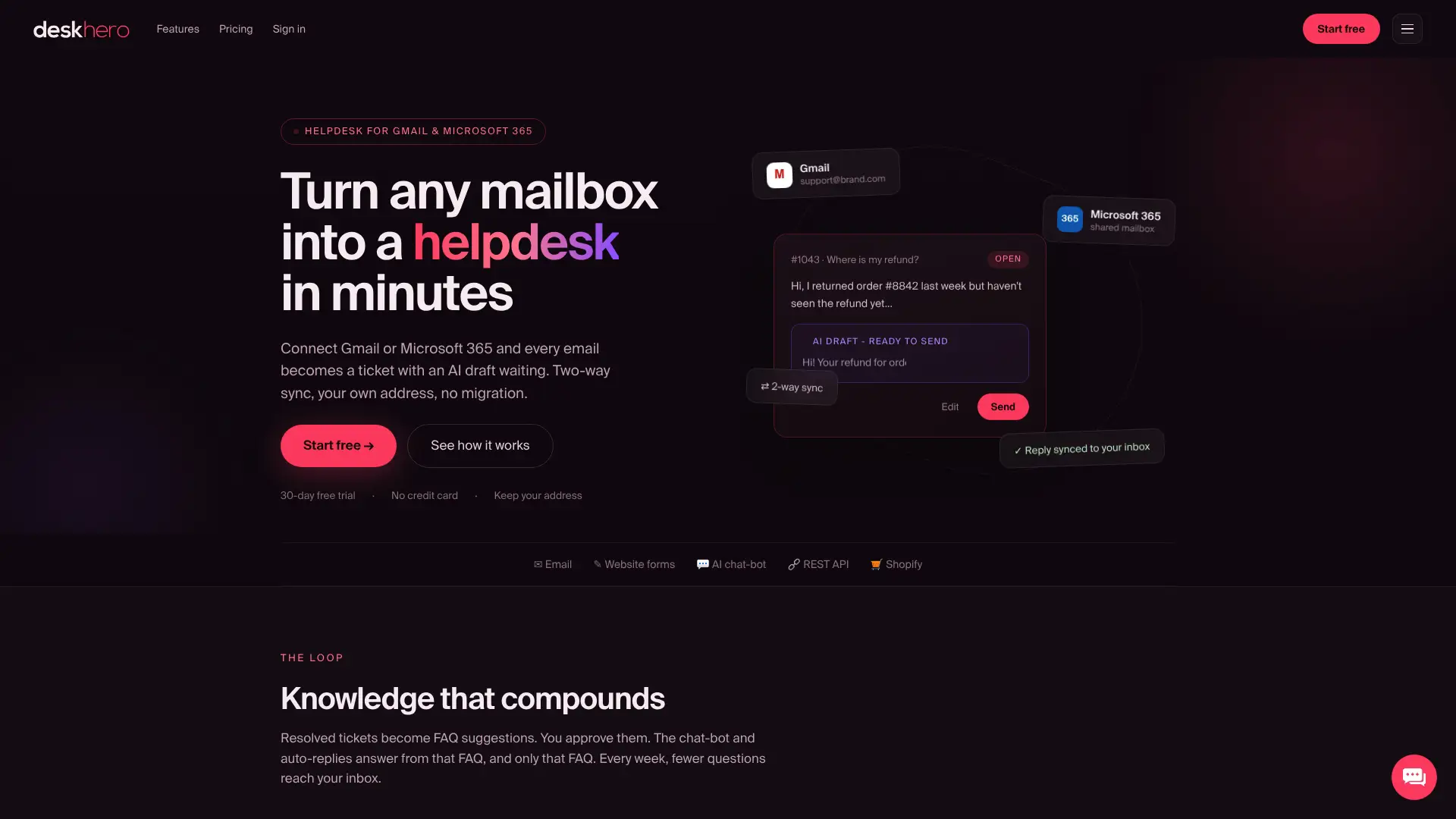
AI reply suggestions can draw from answered tickets, imported sent email, internal knowledge, the approved public FAQ, scraped website pages, and the Shopify product catalog. Customer-facing chatbot and auto-reply answers are more restricted: they use only approved public FAQ items and hand unresolved questions to a human. Automatic features are opt-in, labeled, and logged. The Shopify integration is read-only and surfaces customer and order context inside the ticket. The product interface supports 14 advertised languages and includes a REST API.
Deskhero is built for small and mid-sized support teams that want per-User pricing, controlled customer-facing AI, and a mailbox-first setup. Its 30-day free trial requires no credit card. Use the trial to validate workflows and projected cost before committing.
Sources and further reading
- Gorgias pricing: current description of helpdesk ticket tiers and AI Agent resolution billing.
- Gorgias AI Agent actions for Shopify: supported order actions and setup details.
- Help Scout pricing: current per-User plans, included features, and AI Answers pricing.
- Zoho Desk pricing: editions, channels, AI features, and trial terms.
- Freshdesk pricing: current plan packaging and feature comparison.
- Zendesk pricing: current service plans and add-ons.
- Intercom pricing: current plans and usage-based components.
- Gartner Peer Insights: Gorgias: user reviews that may be filtered for relevant company profiles.
- G2 review of Gorgias: one user review. Treat individual experiences as anecdotal.
A note on vendor content: Pricing and documentation pages are primary sources for current packaging and capabilities, but they are still vendor-authored. Validate important behavior in your own proof of concept.
FAQ
Who are Gorgias’s main competitors?
Alternatives include Zendesk, Freshdesk, Intercom, Help Scout, Zoho Desk, Kustomer, Re:amaze, Front, HubSpot Service Hub, Gladly, HappyFox, Kayako, and Deskhero. The right shortlist depends on Shopify action depth, channels, AI controls, operating model, and total cost.
What is the difference between Gorgias and Help Scout?
Gorgias prices its helpdesk by monthly ticket volume and offers deep native Shopify order actions. Help Scout publishes free and per-User plans, with AI Answers billed per resolution. Help Scout emphasizes shared-inbox collaboration and integrations rather than the same native Shopify action model.
Who is Zendesk’s biggest competitor?
Zendesk competes with broad service platforms including Freshdesk, Kustomer, Salesforce Service Cloud, and others. The closest fit depends on channels, governance, reporting, CRM context, and implementation scope.
What kind of system is Gorgias?
Gorgias is an e-commerce customer support platform with a shared helpdesk, native Shopify integrations, and AI Agent. Supported workflows include human-operated order actions and configured AI actions that can resolve eligible requests.
When does Deskhero make more sense than a full platform migration?
Deskhero is worth considering when your team uses Gmail, Google Workspace, or Microsoft 365 and wants to keep its customer-facing address. It adds a shared helpdesk, AI drafts, an approved public FAQ workflow, and customer-facing AI restricted to that approved FAQ.