Human in the Loop AI: How It Works and When to Use It

Human-in-the-loop AI (HITL) is a design pattern that places human judgment at defined points in an AI system's training, decision, or execution process. It is especially useful when an automated action can affect people or systems, when errors are costly to reverse, or when an organization needs clear human accountability.
This article explains how HITL works, where it helps, and what teams need to design before using it in production.
Table of Contents
- How Does Human-in-the-Loop AI Actually Work?
- Why HITL Matters: Accuracy, Safety, and Trust
- Where HITL Gets Applied: Real-World Examples
- How Do You Design a Production HITL System?
- HITL vs. Human-on-the-Loop vs. Human-over-the-Loop
- What Are the Real Challenges of Running HITL at Scale?
- A Practical Checklist for Deploying HITL Systems
- What Does Current Research Say About HITL's Future?
- Key Takeaways
- The Part Most Teams Get Wrong About HITL
- Deskhero Puts Human Oversight at the Center of AI Support
- Useful Sources
- FAQ
How Does Human-in-the-Loop AI Actually Work?
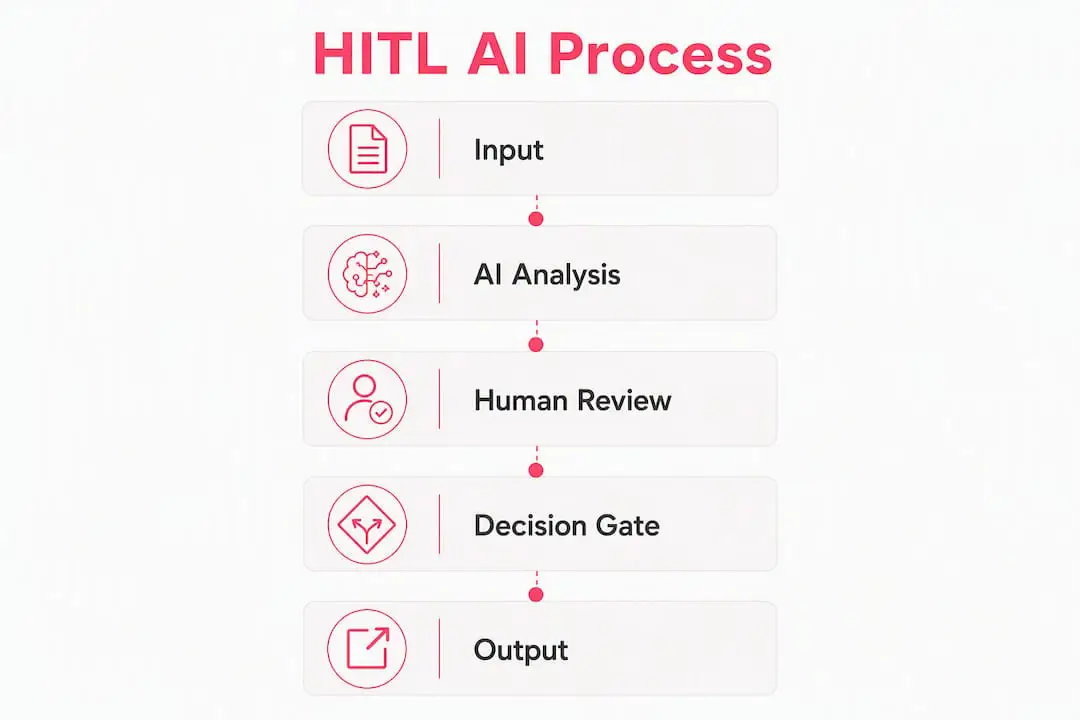
The loop is a sequence of checkpoints where a person supplies information, reviews an output, or authorizes an action. The system may wait for that input, or it may collect the input for later evaluation and model improvement.

Humans commonly participate at two stages:
Training-stage HITL includes labeling raw data, evaluating model outputs, and providing preference signals. Reinforcement learning from human feedback is one well-known example. People rank or assess model responses, and those judgments are used as signals during training. Active learning is another pattern: a model identifies uncertain examples so human labelers can focus on the cases that may provide the most useful information.
Runtime HITL adds review while a deployed system is operating. A system can pause before a sensitive action, such as sending a message or changing a record, and ask a person to approve, edit, or reject the proposed action. The LangChain HITL documentation describes middleware that can interrupt selected tool calls, preserve state, and resume after a reviewer decides what to do.
A useful runtime gate shows the reviewer what the system plans to do, provides structured choices, records the decision, and resumes from persisted state.
A practical flow can include:
- Annotate data or model outputs with human labels
- Train or evaluate a model using those reviewed examples
- Deploy the model or AI workflow
- Interrupt before selected high-risk actions
- Decide whether to approve, edit, reject, or otherwise respond
- Capture the decision as structured operational feedback
Synchronous gates stop the affected workflow until a reviewer acts. Asynchronous designs may let unrelated work continue while the decision is pending. Either way, long-running workflows need durable state. The inference.sh runtime documentation is one example of a system that describes approval gates and persistent execution for this purpose.
Approval rules can be broad or selective. A team might require review for every use of a sensitive tool, or only when an amount, recipient, confidence score, or other condition crosses a threshold. Selective routing can reduce unnecessary reviews without removing oversight from the actions that need it.
Why HITL Matters: Accuracy, Safety, and Trust
Human oversight can improve an AI workflow in three practical ways.
Better handling of edge cases. Models can struggle with unusual inputs or changing conditions. A reviewer can recognize an exception and correct the proposed result. If the correction is captured and governed properly, it can later support evaluation or model improvement. The correction does not improve a model automatically; the team still needs a deliberate feedback pipeline.
Safer actions. An AI system that can send messages, update records, or process transactions can cause harm when it misreads an input. A review gate can reduce that risk by stopping selected actions before they occur. Databricks discusses human review for higher-impact decisions and the value of routing feedback back into the system.
Stronger accountability. A well-instrumented HITL workflow can record who reviewed an action, what they decided, and what happened next. Those records help with incident review, quality control, and compliance. A superficial approval step is not enough. The review needs enough context, time, and authority to change the outcome.
Human feedback is most useful when it is treated as governed operational data. Teams should define how decisions are stored, who can access them, how long they are retained, and whether they will be used for evaluation, retraining, or neither.
Where HITL Gets Applied: Real-World Examples
The pattern appears in many industries, but the reviewer's responsibility changes with the domain.

Medical imaging. A clinician may review an AI-flagged image before using the result in diagnosis or care. The appropriate oversight depends on the device, its intended use, and the applicable clinical and regulatory requirements. AI output should not be described as a substitute for qualified medical judgment.
Content moderation. A classifier can flag potentially violating content and send uncertain or sensitive cases to a human reviewer. People handle context and appeals, while automation helps manage volume. Consistent guidelines and reviewer calibration matter because review decisions may later be used as training or evaluation data.
Customer support. AI can draft a reply for a User to review. Systems with permission to send messages or change account data need additional controls around those actions. A team can require approval based on the type of action, its impact, and how easily it can be reversed. For more background, see Deskhero's article on AI in customer service.
Fraud investigation. A model can score transactions and route selected cases to an analyst. The analyst considers context that may not be represented in the model's inputs and makes the decision required by the organization's policy.
Data-labeling pipelines. Human labelers or domain experts annotate images, text, or audio for supervised training and evaluation. Quality checks, clear instructions, and agreement measures are important because noisy labels can reduce model quality.
Pro Tip: Map the actions a system can take before choosing a review policy. Focus mandatory review on actions that are high impact, difficult to reverse, or subject to a specific accountability requirement.
How Do You Design a Production HITL System?
A production HITL design needs more than a review button. It must account for persisted state, reviewer routing, timeouts, access control, and feedback quality.
Durable execution and state persistence
An interruptible workflow should preserve enough state to resume safely after a decision. In-memory storage may be sufficient for a local test, but it is fragile when a review can take hours or when a service can restart. Choose a supported durable store for the runtime you use, and test recovery from failures before launch.
Approval gate patterns
| Gate type | When to use | Trade-off |
|---|---|---|
| Per-tool approval | Selected sensitive actions | Precise control; more configuration |
| Global approval | Every action in a tightly controlled workflow | Simple policy; can create a large review queue |
| Conditional approval | Review based on an amount, recipient, or risk signal | Selective; requires tested rule logic |
| Ordered review queue | Several dependent decisions in one run | Preserves sequence; can add latency |
Routing and escalation
Define who reviews each class of decision. Some cases require a domain expert, while others can go to a trained general reviewer. Set a target response time and a safe fallback for missed reviews. Depending on the risk, the workflow might remain paused, escalate to another reviewer, or stop without taking the action.
Audit logs and reviewer UI
The interface should help reviewers make informed decisions. Show the proposed action, relevant source information, known uncertainty, and the consequences of approval. Structured choices can make later analysis easier, but reviewers should also have a way to explain an edit or rejection when that context matters.
Pro Tip: Treat the review interface as both a safety control and a data-quality tool. Capture only the information you have a defined reason to use.
For chatbot human handoff, preserve the conversation context, record why automation stopped, and route the resulting request to the appropriate User or queue.
HITL vs. Human-on-the-Loop vs. Human-over-the-Loop
These terms are not used consistently in every field. The following distinctions are a practical framework, not universal definitions.
| Term | Typical timing | Human role | Usually blocks execution? | Common use |
|---|---|---|---|---|
| Human-in-the-loop (HITL) | Before or during a selected decision | Provides input, approval, or correction | Often | Higher-risk decisions and training feedback |
| Human-on-the-loop (HOTL) | During operation | Monitors and can intervene | Usually not | Higher-volume, more reversible activity |
| Human-over-the-loop | Across the system lifecycle | Sets policy and audits outcomes | No | Governance and system-level oversight |
Passive monitoring differs from a gate that requires approval before an action. Many systems combine several oversight levels. They may require direct approval for sensitive writes, monitor lower-risk outputs, and use periodic governance reviews for policies and system performance.
Stanford HAI describes a humans-in-charge perspective that emphasizes meaningful human control. This framing shifts attention toward authority, auditability, and usable review workflows instead of merely counting how often a person touches the process.
Questions that help choose an approach include:
- Can the action harm someone or create a hard-to-reverse change? Consider a blocking human decision.
- Can the result be monitored and corrected quickly? Monitoring with an escalation path may be sufficient.
- Is a regulated or accountable decision involved? Map the control to the actual requirement and document who owns it.
- Is the activity low risk and well understood? Automation with monitoring may be appropriate after testing.
What Are the Real Challenges of Running HITL at Scale?
HITL introduces costs and failure modes that should be addressed during design.
Scalability. Blocking approvals add latency and require human capacity. If every action goes to the same queue, review can become the bottleneck. Risk-based routing can reserve the most intensive review for uncertain or high-impact cases.
Bias and correlated errors. A model trained on human corrections can inherit human biases. A reviewer can also defer too readily to a confident-looking model. Research on alignment and complementarity in human-AI teams examines when a model should match human preferences and when different strengths may improve team performance. Diverse review, calibration, and agreement checks can help expose systematic differences.
Privacy and data governance. Reviewers may see personal, financial, health, or confidential information. Limit access to what a reviewer needs, protect data in transit and at rest, and define retention and reuse policies before collecting review records.
Human fatigue and inconsistency. Repetitive reviews can lead to rushed decisions and changing standards. Useful controls include:
- Set workloads that reflect the complexity of the task
- Run calibration exercises using the same sample cases
- Measure agreement when the task has a defensible reference standard
- Rotate work where doing so does not reduce domain expertise
- Monitor for unusual changes in approval, edit, or rejection patterns
Cost. Human review consumes time and specialist attention. Compare that cost with the expected cost and likelihood of the errors the control is intended to prevent. A gate that reviews everything may cost more while adding little protection.
A Practical Checklist for Deploying HITL Systems
Before deploying a HITL workflow, work through these questions in order.
- Risk assessment. List the actions the system can take. Classify them by impact, reversibility, and accountability requirements.
- Reviewer definition. Identify who may review each action and what information and authority they need.
- Interface design. Show enough context for a real decision. Define approve, edit, reject, and escalation paths where they apply.
- Persistence strategy. Store the state needed to resume safely, and test restarts and duplicate decisions.
- Feedback plan. Decide whether review records are for audit, evaluation, retraining, or a combination. Do not assume they are suitable for every purpose.
- Governance. Assign ownership for review quality, access, retention, routing rules, and control changes.
Useful metrics may include:
- Review rate: the share of eligible actions sent for review
- Time to decision: the delay from interruption to a completed review
- Decision mix: the share approved, edited, rejected, or escalated
- Error outcomes: the problems caught by review and those missed despite it
- Reviewer agreement: consistency on sampled cases where comparison is meaningful
Reduce review only after examining real outcomes. If a category is consistently approved, test a narrower policy under monitoring. If a category is consistently rejected, improve the model or prevent that action instead of adding more reviewers.
What Does Current Research Say About HITL's Future?
Current work increasingly asks how to make human participation more useful, not simply how to add more review.
Research on aligned and complementary models suggests that strong human-AI teams may need both. A model that mirrors a person's judgment can be predictable, while a model with different strengths may catch something the person missed. The right design depends on the task, the available evidence, and how disagreements are resolved.
The humans-in-charge framing also encourages teams to ask whether people have meaningful authority. A reviewer who lacks context, time, or the power to stop an action is not an effective safety control, even if the workflow records an approval.
Patterns worth evaluating include:
- Interrupt-based approvals for selected actions with durable execution
- Structured review forms that capture decisions and useful reasons
- Risk-based routing that combines model signals with the consequences of an action
- Complementarity testing that measures whether a person and model together outperform either one alone
A useful experiment is to group review outcomes by action type and risk band. Look at approval, edit, rejection, incident, and latency rates. The result can show where review is catching meaningful problems and where it is only adding delay.
Pro Tip: Do not optimize for approval rate alone. A high approval rate can indicate a reliable category, weak scrutiny, or a gate aimed at the wrong work. Compare approvals with errors and downstream outcomes.
Key Takeaways
Human-in-the-loop AI is most valuable when the human decision is tied to a clear risk, supported by useful context, and recorded for a defined purpose.
| Point | Details |
|---|---|
| HITL can support training and runtime control | Human input can label data, evaluate outputs, or gate selected actions. |
| Risk-based routing helps control cost | Focus blocking review on actions whose impact justifies the delay and effort. |
| Durable state supports reliable interruptions | A production workflow should survive restarts and long review delays. |
| Meaningful authority matters | Reviewers need context, time, and the ability to change or stop the outcome. |
| Deskhero keeps automatic support features controlled | Its chat-bot and AI auto-replies use approved public FAQ content, are opt-in, and hand unanswered questions to people. |
The Part Most Teams Get Wrong About HITL
A review step can look responsible while adding little protection. If reviewers lack context, approve by habit, or cannot challenge the system, the organization has created a queue rather than meaningful oversight.
The gate should be connected to a specific purpose. If it is meant to prevent harmful actions, measure what it catches and what still gets through. If review data will be used for model improvement, capture why an output was edited and assess whether the labels are consistent enough for that use.
Teams should also distinguish between reducing unnecessary review and weakening human authority. Mature systems can automate well-understood, low-risk categories while giving people better tools and clearer escalation power for the decisions that remain.
HITL is therefore an organizational capability as much as a technical feature. Staffing, policy, training, interface design, and data governance determine whether the loop works.
Deskhero Puts Human Oversight at the Center of AI Support
Deskhero applies several human-oversight principles to customer support. It can draft replies for Users to review. Its customer-facing chat-bot and AI auto-replies answer only from the workspace's approved public FAQ. Both automatic features are opt-in, and automatic actions are labeled and logged.
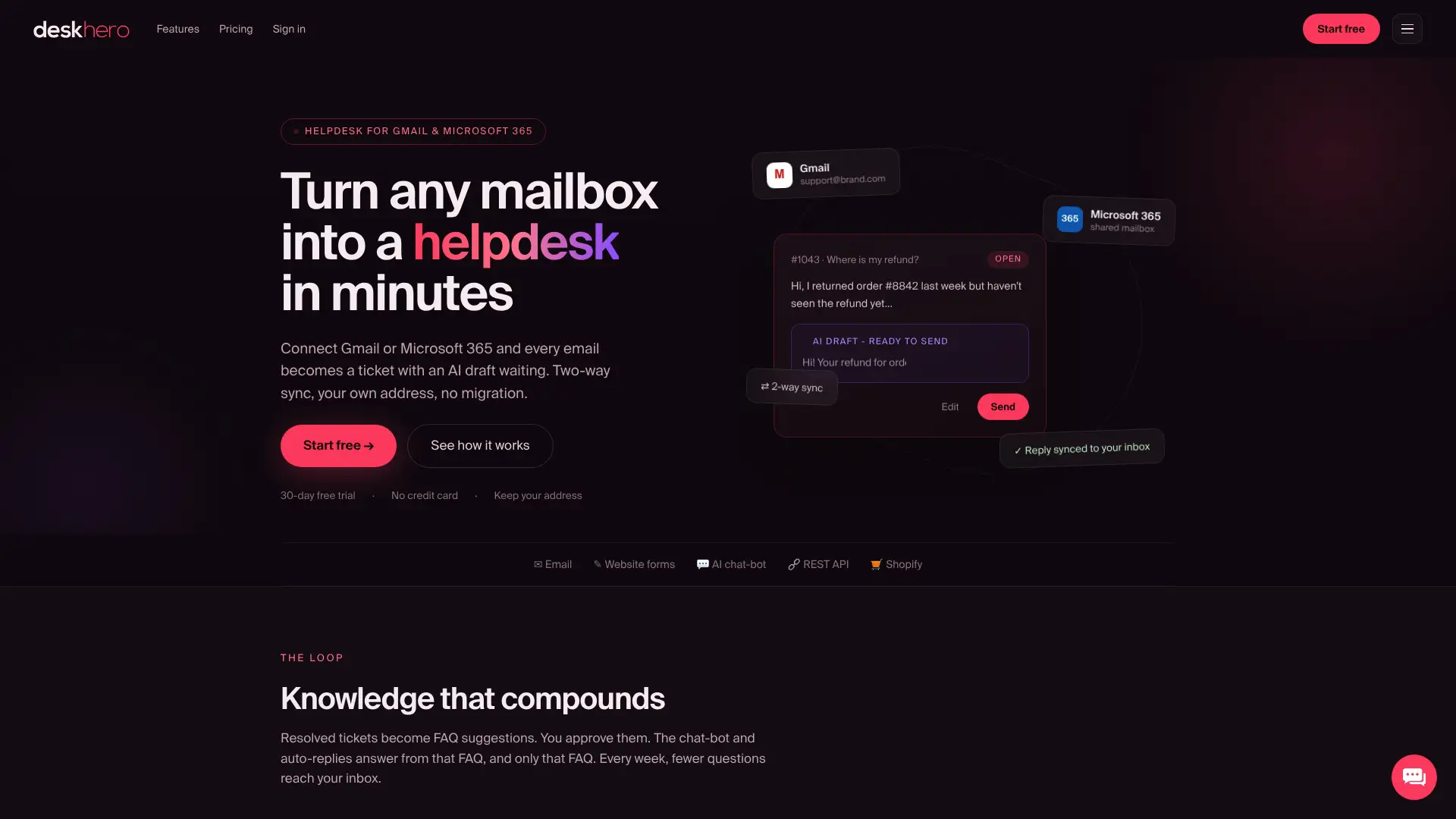
Deskhero suggests FAQ entries from resolved tickets and scraped website pages. A User reviews, edits, approves, or declines each suggestion before it becomes public. The chat-bot requires at least 100 approved public FAQ items. If it cannot answer, it falls back to a form so a person can continue the conversation by email.
For ecommerce teams, the Shopify integration uses read-only access to show customer and order information inside the ticket. Deskhero also offers two-way mailbox connections for Gmail, Google Workspace, and Microsoft 365, so teams can keep their existing email address.
You can start a 30-day free trial without a credit card.
Useful Sources
These sources provide implementation guidance and research context. Check the documentation for the exact version of any framework you use.
| Source | What it covers |
|---|---|
| LangChain HITL documentation | Interrupts, review decisions, persistence, and tool-specific approval configuration |
| inference.sh HITL documentation | Approval gates and durable runtime execution |
| Databricks on human-in-the-loop systems | Human feedback, routing, and operational design |
| IBM: What is human-in-the-loop? | Definitions, common uses, and enterprise considerations |
| Stanford HAI: What is human-in-the-loop? | Human oversight and the humans-in-charge framing |
| Stanford HAI: Humans in the Loop - Design of Interactive AI Systems | Interactive AI design and human-AI collaboration |
| AAAI: Align When They Want, Complement When They Need | Alignment, complementarity, and human-AI team performance |
| Harvard Data Science Review: Data Science and Engineering With Human in the Loop | Human roles in data science, engineering, and oversight |
| PMC: Human-in-the-loop approaches in clinical AI | Clinical applications and human oversight |
FAQ
What does human-in-the-loop mean in AI?
Human-in-the-loop AI places human input at a defined point in an AI process. A person may label data, evaluate an output, correct a result, or approve an action before it occurs.
What is the difference between human-in-the-loop and human-on-the-loop?
In common usage, HITL requires human input for a selected decision and often pauses the affected workflow. Human-on-the-loop usually describes a system that operates while a person monitors it and can intervene. Terminology varies, so a system description should state the actual control instead of relying on the label alone.
What is human-in-the-loop for AI agents?
For AI systems that can take actions, HITL often means pausing before a selected action, showing the proposal and relevant context to a reviewer, and resuming only after an allowed decision. The workflow should preserve state and record what the reviewer chose.
What is human-on-the-loop in AI?
Human-on-the-loop generally means that an AI system operates while a person monitors outcomes and can stop, correct, or override it. It usually does not require approval before every action.
How does Deskhero implement human-in-the-loop AI for support teams?
Deskhero drafts replies for Users to review. Its chat-bot and AI auto-replies are opt-in and answer only from the approved public FAQ. Automatic actions are labeled and logged, and unanswered chat questions fall back to a form for human follow-up by email.